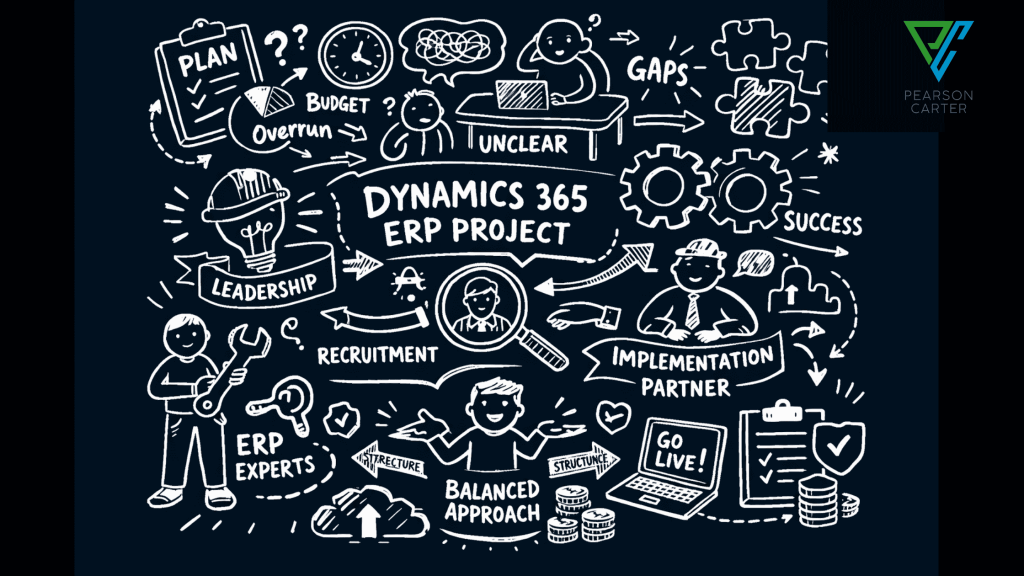
Dynamics 365 Implementation Services: Why ERP Delivery Fails Without the Right Talent
When organisations invest in Microsoft Dynamics 365, they are entering one of the fastest-growing enterprise technology markets globally.The global ERP software market is projected to grow to $78.4 billion by 2026, and forecasts suggest it could approach $96 billion by 2032, expanding at a compound annual growth rate of around 7% (source: Oracle NetSuite).At the same time:
50% of companies are acquiring, upgrading, or planning to update ERP systems
62% of IT decision-makers say digital transformation is a high priority
Legacy system replacement and technology consolidation remain top drivers for ERP adoption
ERP transformation is accelerating across manufacturing, IT, healthcare, and more.But there is a second market growing just as fast, the market for ERP talent.As more organisations implement or upgrade systems like Microsoft Dynamics 365, demand increases for:
ERP Project Managers
Solution Architects
Functional Consultants
Business Central and F&O Developers
Data and integration specialists
In other words, ERP growth is directly impacting recruitment pressure.And when demand outpaces supply, project risk increases. This article covers how to tackle the second risk (i.e., recruitment problems).
The overlooked risk in Dynamics 365 implementation services: Talent Gaps
When organisations evaluate dynamics 365 implementation services, most of the attention goes toward selecting the right partner.But ERP projects do not fail because a partner cannot configure software. They fail when there is a capability gap inside the organisation. That gap is also widening as the ERP market evolves. That means more Dynamics 365 implementations are happening simultaneously and demand for experienced professionals is increasing just as fast.This creates pressure in three key areas:
Experienced ERP Project Managers
Dynamics 365 Functional Consultants
Solution Architects and Platform Owners
When organisations cannot secure the right talent early, implementation services providers are forced to compensate for weak internal ownership. And that’s the point where projects start to pivot. And the drift happens because:
Decision-making slows
Scope control weakens
Governance becomes reactive
Internal accountability blurs
ERP transformation cannot be fully outsourced. It requires strong internal leadership working alongside external implementation services.This is where recruitment becomes directly tied to delivery success.Hiring a general IT project manager instead of an ERP-experienced leader can increase project risk. Delaying the appointment of a Dynamics 365 Business Central or F&O specialist can extend stabilisation by months. Failing to secure a long-term Platform Owner often results in post-go-live performance decline.In other words: Talent strategy is implementation strategy.
Implementation Timelines: A Delivery and Talent Question
When organisations review proposals from dynamics 365 implementation services providers, one of the first comparisons is timeline.Why does one partner estimate six months, while another suggests twelve?Shorter timelines typically require:
Highly experienced Dynamics consultants
Strong internal decision authority
Dedicated subject matter experts
Mature governance structures
Compressed delivery increases risk when these elements aren’t there. In contrast, longer timelines include:
Limited internal availability
Capability gaps in ERP leadership
Complex legacy environments
Heavy customisation requirements
In many cases, delays are not caused by technical complexity alone. They are caused by insufficient expertise or overstretched teams.Organisations that underestimate the talent required for ERP transformation frequently experience:
Higher rework rates
Slower user adoption
Post-go-live stabilisation periods extending by 6–12 months
And this is where recruitment strategy directly influences project outcomes.
Why governance and recruitment are interconnected
Governance is often described as a framework, a steering committee, or a reporting structure. In reality, governance is a capability.And capability depends on having the right people in the right roles.In a Dynamics 365 implementation, effective governance typically requires:
An ERP-experienced Project Manager with authority to control scope
A Technical Lead who understands architecture and integration risk
A Functional Consultant who translates business processes accurately
A Data Architect who protects data quality and migration integrity
A Platform Owner responsible for long-term system performance
Without clearly defined accountability across these roles, implementation services can become fragmented. Decisions slow down. Scope expands informally. Ownership becomes unclear.This is particularly true in mid-sized organisations adopting Microsoft Dynamics 365 Business Central, where internal ERP experience may be limited and governance structures are still evolving.In these cases, the issue is rarely partner capability. It’s more of an internal readiness issue. Bringing in the right permanent hire or interim specialist early in the programme reduces rework, shortens stabilisation periods, and strengthens long-term platform ownership.In other words, governance is not something you write, but it is something you staff.
Where Dynamics 365 projects start to break down
From a recruitment and delivery standpoint, project risk often begins with role misalignment. Some common mistakes we see include:
Hiring a general IT Project Manager instead of an ERP-specific PM
Underestimating the importance of a Dynamics Solution Architect
Delaying the recruitment of a Business Central or F&O Developer
Failing to appoint a long-term Platform Owner post-go-live
These gaps often surface 6–12 months into delivery, when budgets are already committed.Correcting them later is significantly more expensive than hiring correctly from the start.
ERP “success” is a capability strategy
Selecting the right dynamics 365 implementation services is essential.But implementation success depends on three pillars:
The partner
The delivery framework
The talent
When any one of these is weak, project risk increases.When all three are aligned, Dynamics 365 becomes a platform for operational growth rather than an expensive recovery exercise.
Moving forward with confidence
For organisations working with Microsoft Dynamics 365, avoiding failure is less about restarting and more about recalibrating.A focused assessment should review:
Governance clarity
Decision-making speed
Customisation strategy
Stakeholder engagement
Delivery cadence
Clear gaps can usually be corrected without restarting the programme.This is where specialist recruitment becomes strategically important.As a specialist technology recruitment partner operating across Microsoft technologies, Pearson Carter works with organisations globally to secure the talent that underpins successful ERP delivery. ERP transformation is demanding, but it is predictable when structured correctly.