

X
Upload CV
5 ways delivery managers lead to success in Dynamics 365 ERP projects
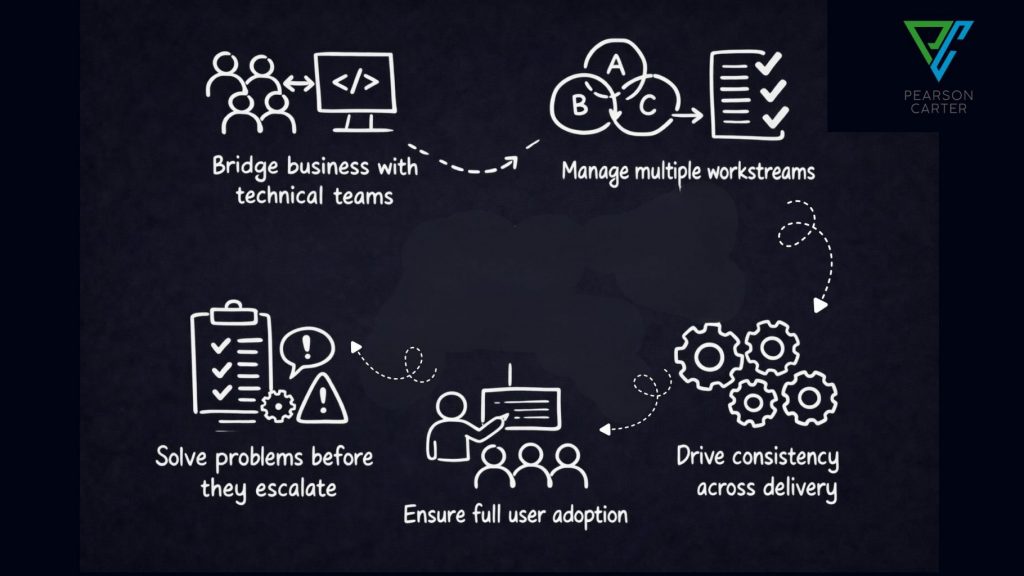
Delivery Managers are an important asset in Microsoft Dynamics 365 Business Central projects because they connect technical delivery with business outcomes. As ERP implementations become more complex and cloud-driven, execution (not technology) is where most risk sits.
With nearly 67% of projects failing due to poor alignment or execution, Delivery Managers provide the structure and coordination needed to keep delivery aligned with business goals (source: Harvard Business Review).
Thus, as organisations continue investing in Microsoft Dynamics 365 Business Central and similar ERP platforms, the complexity of delivery has increased.
Organisations with strong delivery governance are 2x more likely to meet project goals (PMI), which is a trait Delivery Managers bring to the table. They own the entire delivery stream, end-to-end, and manage overall business value.
Here are 5 reasons why Delivery Managers are important to your ERP success:
1. They close the gap between business and technical teams
Delivery Managers act as the central link between stakeholders and technical teams. In Dynamics 365 Business Central projects, this is an important trait because business requirements are complex to translate directly into system configuration. When there’s no clear alignment:- Developers build based on assumptions
- Functional consultants interpret requirements differently
- Business users feel disconnected from the solution
- Business requirements are translated into clear, actionable plans
- Technical teams understand the why, not just the what
- Stakeholders stay aligned throughout the project lifecycle
2. Delivery Managers manage complexity across multiple workstreams
In a typical Business Central programme, there are different workstreams, such as Core ERP implementation, E-commerce integrations (Shopify, Magento), SaaS tools (CRM, payments, logistics), and more. Each of these runs as a separate workstream, often with different teams and timelines. However, these different entities have to be unified at one point. If there’s no coordination, teams may duplicate efforts or miss dependencies. Delivery Managers manage this complexity by:- Balancing workloads across teams
- Tracking interdependencies
- Prioritising tasks based on business impact
3. How delivery managers manage user adoption
Delivery managers manage user adoption for an ERP system by ensuring that it is operationally adopted. That is a failure point in Dynamics 365 Business Central projects: the system can have every feature live, but end-users may not fully understand how to use it. This leads to:- Workarounds outside the system
- Low usage of key features
- Inconsistent processes
- Delayed ROI
- Integrate training into the project timeline (not post go-live)
- Align system design with real user workflows
- Ensure documentation is practical and usable
- Coordinate feedback loops between users and delivery teams
4. They Drive Consistency Across Teams and Projects
In growing organisations, multiple ERP projects often run simultaneously. But when there’s no standardisation:- Each team follows different processes
- Quality varies across deliverables
- Reporting becomes inconsistent
- Leadership loses visibility
- Defining delivery standards
- Aligning teams on processes and tools
- Standardising reporting structures
- Ensuring quality benchmarks are met
5. They Improve Delivery Efficiency and Resource Utilisation
One of the most overlooked challenges in ERP programmes is resource allocation. Because teams can be overloaded in some areas and underutilised in others. That leads to misalignment in project priorities. Without visibility across all workstreams, inefficiencies go unnoticed – but not by delivery managers as they help unblock this by:- Monitoring team capacity
- Reallocating resources dynamically
- Balancing workloads across projects
- Ensuring critical paths are properly staffed
Where many organisations struggle with hiring delivery managers
Despite the clear value, many organisations delay hiring Delivery Managers or assume Project Managers can absorb the role. This creates problems as project managers typically focus on:- Individual project timelines
- Scope and budget control
- Stakeholder communication within a project
- Across multiple projects
- Across multiple teams
- Across the entire delivery function
- Escalations become fragmented
- Teams may operate in silos
- Leadership loses visibility
- Delivery becomes reactive instead of controlled
Final Thoughts
ERP success is defined by how well you deliver it, and that delivery is now much more complex. You have more integrations, more stakeholders, and a ton of moving parts that have to be accounted for. Without someone owning that complexity, projects start to misalign, which makes the role of Delivery Managers all the more important. They bring structure, clarity, and deliver outcomes that align with business goals. But this is not a generic role. Strong candidates typically combine:- ERP delivery experience (Dynamics NAV / Business Central)
- Operational leadership capability
- Stakeholder management skills
- Technical awareness (without being hands-on developers)

JOBS BY SECTORS