

X
Upload CV
How is AI changing front end development?
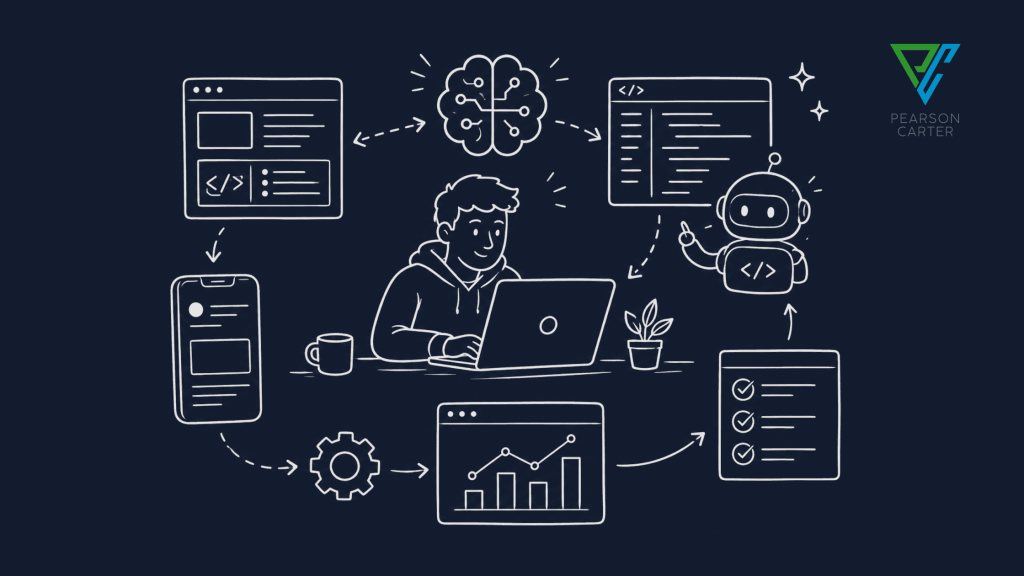
For years, becoming a front-end developer followed a predictable path: master HTML, CSS, JavaScript. Learn React or Vue. If you wanted to go an extra mile, a good portfolio always came in handy. But now, the path is different.
Because in 2026, front-end development isn’t just about writing cleaner code anymore. You have AI now that helps automate manual tasks and make them obsolete.
Job postings now list “experience with AI tools” as a requirement. Developers who embraced CoPilot six months ago are already ahead of those still writing every line by hand. And organisations are now restructuring teams around this new reality.
So here’s the real question: if you’re thinking about becoming a front-end developer in 2026, what should you be expecting?
The Old Path vs. The New Reality
The traditional front-end developer roadmap is now changing. The main thing is how the velocity of work expectations has changed. Five years ago, a junior developer spending two weeks building a feature was normal. Now companies expect that same feature in three days because you have tools like Cursor, Lovable, and so many more to help code and detect bugs.What skills should front end developers focus on in the AI era?
We’ve gathered these skills from open roles so you know what’s happening right inside the market.1. JavaScript Fundamentals (Non-Negotiable)
AI tools won’t write your logic. They’ll accelerate it. CoPilot can auto-complete a function. But it can’t design a system architecture. It can’t make decisions about state management. It can’t understand your business requirements. What it can do is write boilerplate faster. Handle repetitive patterns. Generate test cases. Spot syntax errors. That means JavaScript fundamentals matter more than ever—because you need to understand what the AI is suggesting, catch where it’s wrong, and know how to refactor it. If you’re weak on fundamentals, AI tools become dangerous. You’ll ship broken code that looks right.2. Framework Knowledge (Vue or React)
Vue or React—pick one. The “which is better” debate is noise. Both are in demand. Both have strong job markets. The framework itself is secondary. Understanding the component architecture, state management, and how to structure applications is important. CoPilot will generate Vue or React code for you. Your job is understanding why it’s structured that way, because that understanding transfers across frameworks. Once you grasp how frameworks think about components and state, switching from Vue to React (or vice versa) takes weeks, not months. The underlying concepts are identical. The syntax changes. The thinking stays the same. Go deep on one. Master it. Then the other becomes a syntax translation problem, not a learning problem.3. Working Effectively with AI Tools (This is New)
Using CoPilot isn’t passive. You don’t turn it on and let it write your codebase. Effective AI-assisted development means:- Writing clear prompts that guide the AI toward the solution you want
- Knowing which tasks to delegate to AI (scaffolding, boilerplate, test generation)
- Knowing which tasks to keep for yourself (architecture, complex logic, critical decision-making)
- Reviewing AI-generated code with a critical eye
- Understanding when the AI is suggesting something suboptimal
4. Problem-Solving Over Syntax Memorization
Here’s what AI has done to coding: it’s made syntax memorization irrelevant. You don’t need to memorize the exact syntax of Array.filter(). You don’t need to remember the difference between map and reduce off the top of your head. CoPilot will remind you. What you need is problem-solving. Can you break a complex feature into smaller pieces? Can you think through edge cases? Can you design a solution that won’t break when requirements change? That’s what separates developers who can ship quality work from developers who ship bugs with confidence. And that’s what AI can’t do for you.5. Soft Skills (Communication, Collaboration, Ownership)
If everyone has access to the same AI tools, the difference between developers isn’t coding speed anymore. It’s:- How clearly they communicate with stakeholders
- How well they collaborate with designers and product managers
- How they think about user experience
- How proactively they identify and solve problems before they’re asked
How to become a front end developer in 2026? The most asked question
Phase 1: Fundamentals
- JavaScript basics (variables, functions, loops, objects)
- DOM manipulation
- Async JavaScript (promises, async/await)
- Start using AI tools now. Don’t wait until phase 3.
- Generate boilerplate code
- Suggest refactorings
- Catch syntax errors
- Explain concepts you don’t understand
Phase 2: Framework Mastery
- Pick Vue or React
- Build 2–3 projects of increasing complexity
- Understand state management
- Learn component architecture
- Component scaffolding
- Test generation
- Refactoring suggestions
- Performance optimization ideas
Phase 3: Building Real Projects
- Build 3–5 portfolio projects
- Make them solving real problems
- Use AI tools in your actual workflow
- Get feedback from experienced developers
Phase 4: Job Search & Career Entry (Ongoing)
- Target roles that explicitly mention AI tool experience
- Apply to companies using modern stacks (Vue, React)
- Network with other developers
- Keep building and learning
The best time to start is today
Using AI in front-end development is the only way to make the cut. Waiting for “the right time” to learn CoPilot, or thinking you’ll pick up AI tools after you land your first job, is a losing strategy. By then, candidates who started now will already be shipping features in half the time. The developers who’ll dominate this space in 2027, 2028, and beyond are learning now. You can spend the next year learning the old way. Or you can start today—JavaScript, Vue or React, AI tools integrated from day one—and be six months ahead of everyone else. Our advice: don’t overthink this.Ready to break into front-end development?
Pearson Carter specialises in placing front-end developers globally across hybrid and remote roles—including positions that explicitly value AI tool experience and modern development workflows. We work with companies building the future right now.
JOBS BY SECTORS