

X
Upload CV
Technical Leadership to Executive Strategy in D365: 2026 Guide
You’ve spent years climbing the technical ladder. You know Dynamics 365 CE inside out. You’ve solved complex business problems with code and configuration. But now, times have changed.
Now, problems that hold weight to the business aren’t technical problems anymore. And it’s where senior technical people get stuck.
They’ve mastered technical leadership: managing developers, architecting solutions, delivering projects on time. But executive strategy is a different game entirely.
The jump from Senior Developer or Technical Lead to Director or VP of Enterprise Solutions is significant. And it’s not something that happens naturally just because you’ve been in the industry for 10 years.
So here’s what to keep in mind when you’re making this jump.
What Changed (And Why Your Technical Skills Aren’t Enough)
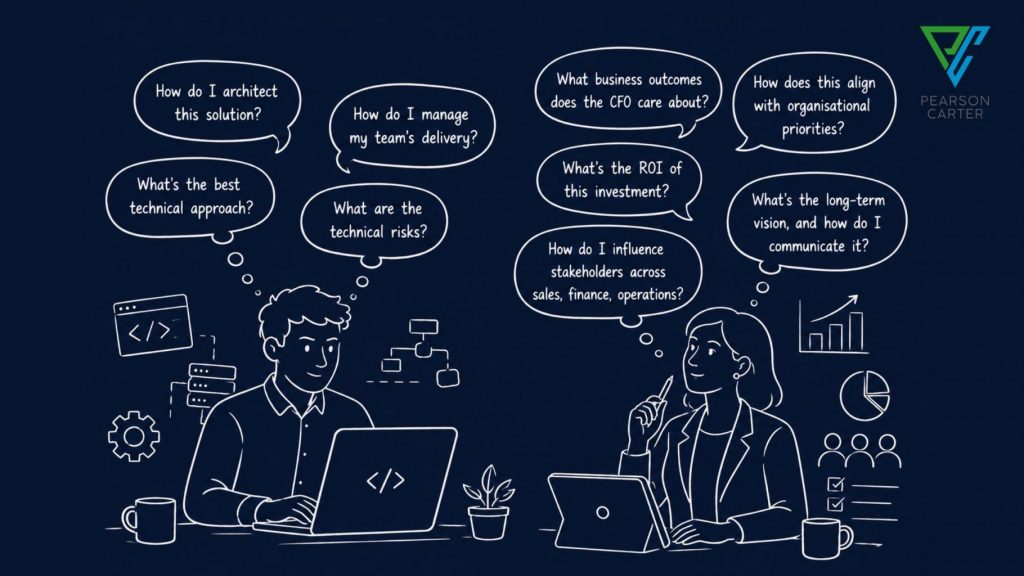
Let’s be direct: your technical expertise got you here. It won’t get you past here. As a Senior Technical Leader, your job was solving defined problems. Build this feature. Fix that bug. Optimize this process. Deliver this project. The metrics were clear: velocity, quality, uptime, user adoption within your team. As an Executive Leader owning enterprise strategy, your job is defining which problems matter. It’s not about solving them faster. It’s about making sure you’re solving the right problems—the ones that move the business forward. This requires a completely different skill set.The Technical Leader Thinks:
- “How do I architect this solution?”
- “What’s the best technical approach?”
- “How do I manage my team’s delivery?”
- “What are the technical risks?”
The Executive Leader Thinks:
- “What business outcomes does the CFO care about?”
- “How does this align with organisational priorities?”
- “What’s the ROI of this investment?”
- “How do I influence stakeholders across sales, finance, operations?”
- “What’s the long-term vision, and how do I communicate it?”
What skills do you need to develop?
You don’t need to unlearn what you know about D365. You need to layer on skills you’ve probably never developed before.1. Business Acumen Over Technical Depth
As a technical leader, you understood the business through the lens of technology. “We need better CRM data quality because it impacts reporting accuracy.” As an executive, you need to understand the business first, then think about how technology enables it. “Sales effectiveness is dropping because CRM data quality is poor. We need a data governance strategy. Technology is a means to that end.” This shift is subtle but massive. You need to understand:- How your organisation makes money
- What drives profitability in your industry
- What the CFO, CRO, and COO actually care about
- How enterprise CRM and automation directly impact those metrics
2. Strategic Communication (Not Technical Communication)
Technical communication is about clarity and precision. You explain how things work. Executive communication is about influence and alignment. You explain why things matter and what it means for the business. A technical presentation: “Here’s our architecture for the new CRM system. It uses REST APIs for integration, follows Microsoft best practices, and will handle 10x current transaction volume.” An executive presentation: “Our sales team is losing opportunities because our CRM isn’t integrated with our ERP. This fragmentation costs us roughly $500K annually in missed follow-ups and duplicate data entry. A unified D365 CE strategy eliminates this friction, improves data quality, and reduces sales cycle time by 15%.” Same project. Completely different framing. You need to learn to speak the language of business impact, not technical achievement.3. Stakeholder Management Across Functions
As a technical leader, you managed technical teams and sometimes partnered with business teams. As an executive, you’re managing upward (CFO), laterally (peers in sales, operations, finance), and downward (your team). Each stakeholder has different priorities. Your job is translating your vision in a way that resonates with each. Sales wants efficiency. Finance wants cost control and compliance. Operations wants stability. Your team wants clear direction and resources. You can’t make everyone happy. But you need to understand what each cares about and communicate how your strategy serves those interests.4. Long-Term Vision Over Quarterly Delivery
Technical leaders think in cycles: sprints, projects, milestones. “This quarter we ship X. Next quarter we build Y.” Executive leaders think in multi-year strategies: “Over three years, we’re transforming how this organisation manages customer relationships. Year one is data foundation. Year two is automation and efficiency. Year three is predictive insights and competitive advantage.” This requires thinking about:- Where the industry is heading
- What capabilities you need to build
- How to prioritize investments across years
- How to communicate a vision that keeps people focused through quarters of unsexy foundational work
5. Managing Through Ambiguity and Politics
Technical problems have right answers. A bug either is or isn’t. A solution either scales or doesn’t. Business problems don’t have right answers. There are trade-offs, competing priorities, and organisational politics. As an executive, you need to:- Make decisions with incomplete information
- Navigate organisational politics without losing credibility
- Influence outcomes you don’t control
- Handle situations where the “right” technical answer isn’t the right business answer
What prepares you for the leap?
If you’re a senior technical leader considering this transition, here’s what will actually help:- Get Executive Exposure Now Ask your current leadership if you can sit in on strategic planning meetings, budget reviews, board discussions. Understand how executives think about the business.
- Take on Cross-Functional Projects Lead initiatives that require coordinating across sales, finance, operations. Learn what each function cares about.
- Study Business Fundamentals Read business books. Understand financial statements. Learn how organisations create value. This isn’t optional.
- Find an Executive Mentor Not a technical mentor. An actual executive who can coach you on strategic thinking, stakeholder management, and business acumen. This matters more than any certification.
- Practice Strategic Communication Start presenting to non-technical audiences. Get feedback. Learn to translate technical work into business impact.
- Build Hands-Off Leadership Skills If you’re currently a hands-on technical leader, start delegating. Practice leading through others instead of doing the work yourself.
The Path Forward
If you’re a senior technical leader in D365 considering the move to executive strategy: Start thinking like an executive now. Don’t wait for the role. Understand your organisation’s business drivers. Learn stakeholder management. Study how decisions get made at the executive level. Find mentors who’ve made this transition. The technical skills you have? They’re your foundation. The organisations that need D365 strategic leadership are willing to pay significantly for people who can think both ways. But they’re rare. Be one of them.Ready to make the transition to executive leadership in Microsoft enterprise solutions?
Pearson Carter specialises in placing senior D365 and Power Platform leaders across the globe, roles that value both technical depth and strategic business thinking. We understand what executive teams need.
JOBS BY SECTORS