

X
Upload CV
How to become a cloud architect in 2026: A five-step guide
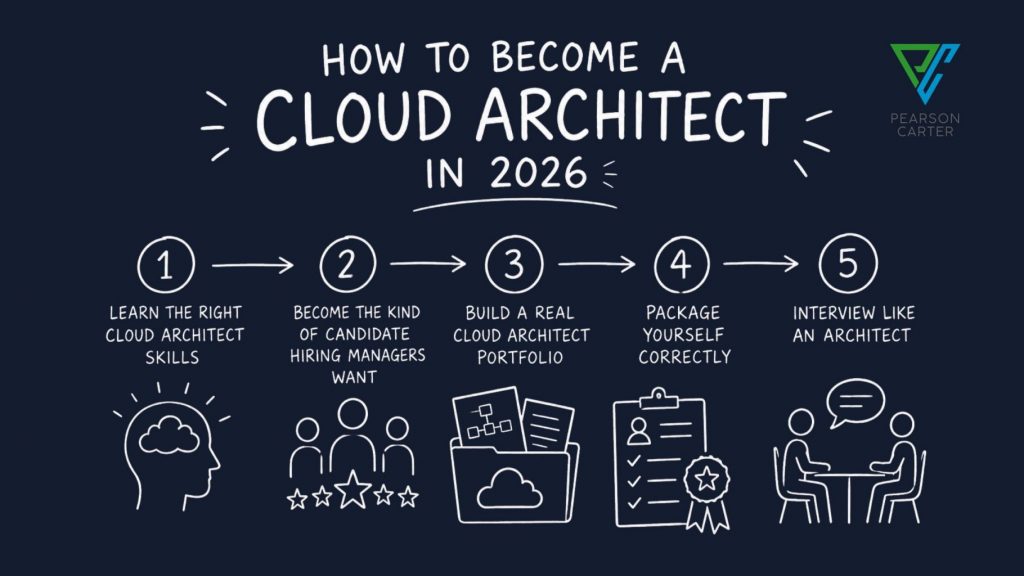
Cloud architecture is one of the absolute best career paths out there. People who make it into these roles typically come with 5-10 years of experience. But technical skills aren’t the only thing that get you the job.
For a career in cloud architecture, you need to have four sets of skills: technical, business, communication, and executive. A good grip on all these skillsets helps folks progress in their career faster.
This blog covers the five-step path to becoming a cloud architect in 2026: the right skills to build, what hiring managers look for, how to put together a portfolio that proves you can do the job, how to package yourself correctly, and how to perform in the interview.
Let’s begin!
Step One: Learn the right cloud architect skills
Cloud architecture and cloud engineering are very different roles. A cloud engineer is implementing the strategy: building, configuring, deploying, troubleshooting. A cloud architect is designing that strategy. As an architect, you decide what should be built, why it should be built, and how it will support the business. You evaluate trade offs across risk, cost, performance, security, and business priorities. Where a cloud engineer needs to be an expert on deploying a VNet or VPC, a cloud architect is looking at whether the entire network architecture supports security, compliance, and the company’s long-term direction. You need credibility in compute, storage, networking, security, data architectures, and application architectures. But you also need to understand how the business works, how executives think, and how to communicate clearly. The stronger your business and communication skills, the more valuable you become as an architect. And in most cases, that translates directly into more promotions and higher pay.Step Two: Become the kind of candidate hiring managers want
Hiring managers do not just hire skills. They hire trust, confidence, communication, and judgment. Plus, 92% of hiring managers consider soft skills equally or more important than technical skills when making hiring decisions. For an architect role, that number makes complete sense. On any given day you’ll be working with engineers, developers, security teams, finance teams, operations, vendors, and executives. So when a hiring manager evaluates you, they’re asking:- Can this person communicate clearly?
- Can they explain complex ideas simply?
- Can they evaluate trade offs, make sound decisions, and work under pressure?
- Can I put this person in front of executive customers and senior technical leaders?
Step Three: Build a real cloud architect portfolio
Your portfolio is the evidence that you can do the job. This is where many candidates fall short. They have certifications, labs, and technical projects, but no proof that they can think like an architect. A portfolio full of labs shows you can follow instructions. It does not show that you can design an architecture, justify it, and communicate your decisions to senior leadership. Your portfolio should contain the work architects actually produce: cloud strategy artifacts, target architecture diagrams, migration roadmaps, cloud landing zone designs, reference architecture patterns, cost optimisation plans, architecture decision records, executive presentations, RFP responses. These are the things that show a hiring manager how you think, how you communicate, and how you make decisions. When your portfolio is strong, a hiring manager does not have to guess whether you can do the work. They can already see it. Make it clear, professional, and business-focused, and treat it as seriously as you treat any other part of your application.Step Four: package yourself correctly
Once you have the skills and the proof, you need to present yourself correctly, through certifications, your resume, and LinkedIn. On certifications: they help you get through filters, attract recruiters, and support your credibility. But they do not replace architecture skills, business acumen, or communication ability. Be selective. For cloud architects, one strong cloud certification is sufficient, AWS Solutions Architect Professional, Azure Solutions Architect Expert, or Google Professional Cloud Architect. Pair that with TOGAF 10 for architecture frameworks, and the CISSP to show that security is part of how you think. Twenty certifications across unrelated areas does not position you as an expert in your target role. Your goal is to be a great architect, not a certification collector. On your resume: it has one job, to get you the interview. It is not a full record of everything you have done. It is a positioning document. In the first five seconds, a hiring manager should be able to identify what role you want, why you are credible for it, and what business value you can deliver. Highlight design work, strategy work, migration planning, stakeholder management, cost optimisation, governance, and business outcomes. Do not just list what you worked on, show what improved as a result. Lower costs, better scalability, reduced risk, faster delivery. That is what architects are evaluated on. On LinkedIn: recruiters search LinkedIn every day. Your headline needs to be clear. Your about section should speak directly to what you can deliver as an architect for a business. Your featured section should include your portfolio. Your posts should reflect architecture thinking, cloud strategy, trade offs, cost optimisation, security, governance, business outcomes. When hiring managers and recruiters come across your profile and your content, they should be able to say with confidence: this person thinks like an architect.Step Five: Interview like an architect
The interview is not a technical quiz. It is where you demonstrate that you can operate as a cloud architect. Many technically strong candidates struggle in architect interviews, not because of a lack of knowledge, but because they answer like engineers. A cloud architect interview is an executive-level conversation. You will be asked technical questions, but the hiring manager is evaluating how you think, how you communicate, and how you make decisions, not just what you know. When you answer a question, structure your response around: what was the business situation, what options were considered, what trade offs mattered, what you recommended, and what the outcome was. That is how architects communicate. If asked about a cloud migration, do not say “I migrated servers to AWS.” Instead, speak to the business constraint that existed, why a phased migration strategy was recommended over other options, how the cloud foundation was established to manage risk, and what the business achieved as a result. That answer shows business context, decision-making, governance, and leadership, which is exactly what the hiring manager is looking for. Build rapport early. Be straightforward and professional. If you do not know something, say so directly, explain where your expertise lies, and show that you are motivated to close any gaps. Honesty builds trust, and trust is what gets you hired.
JOBS BY SECTORS