

X
Upload CV
What is an IT Portfolio Manager?
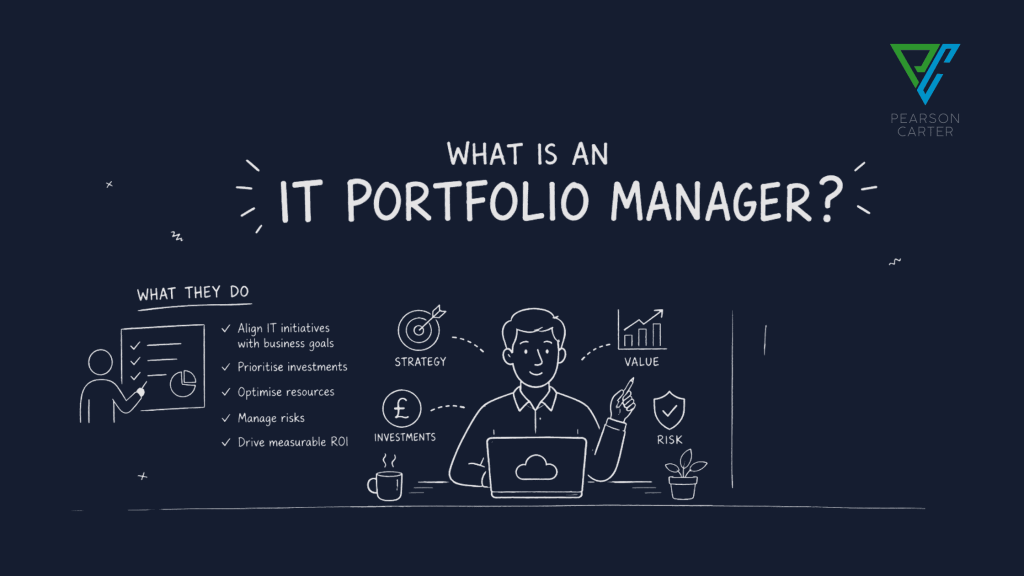
An IT Portfolio Manager is a strategic professional who oversees an organisation’s collection of technology investments, applications, and initiatives. They align IT resources with business goals, optimise budgets, minimise risks, and ensure each investment delivers measurable ROI. Think of it as financial portfolio management applied to technology spending.
Most organisations run between 50–200 concurrent IT initiatives simultaneously. Without oversight, projects miss deadlines, budgets balloon, and money disappears into wasted resources. According to Project Management Institute research, poor portfolio management costs organisations 11% of their IT investment budgets, roughly £5.5 million annually for a £50M IT department.
Portfolio Managers create visibility into these problems. They sit between IT operations (the people executing work) and leadership (the people making strategic decisions). They’re the translator, tracker, and decision-maker.
What role do IT Portfolio Managers play?
Portfolio Managers answer critical business questions daily: Which initiatives should be funded? How should resources be allocated? Which projects deliver value? What happens when priorities conflict? They operate across four core areas: Strategic Alignment. All planned and active IT projects must contribute directly to company long-term objectives. This means saying “no” to technically interesting projects that don’t move the business forward. Investment Prioritisation. Every pound spent on IT is a pound not spent elsewhere. Portfolio managers evaluate project proposals, establish prioritisation frameworks, and decide what gets funded, and what doesn’t. Resource Allocation. IT organisations have finite resources. Portfolio managers distribute financial, human, and technical resources across the entire portfolio. They make trade-offs visible: fund this initiative, and you can’t fund that one. Performance Monitoring. Using KPIs and ROI metrics, portfolio managers track progress and maintain project governance. They force accountability. No more initiatives disappearing into uncertainty.Why are organisations hiring for this role?
Demand for portfolio management is surging because the problem it solves is now urgent at scale. Digital transformation accelerated. Cloud adoption became mandatory. Cybersecurity became existential. Remote work changed infrastructure requirements. Organisations went from running 10–15 major initiatives to running 50–200. But most still operate with governance designed for sequential projects. Spreadsheets replace systems. Weekly status meetings mask chaos. Gartner reports CIOs expect IT portfolios to grow 15–20% annually over the next three years. More initiatives means more need for portfolio visibility. But supply is limited, portfolio management skills aren’t being developed at scale because the role is new.What skills do you need?
This isn’t a technical role. You don’t code or configure systems. Instead, you need: Financial thinking. Understand how organisations create value. Think like a financial portfolio manager. You’re making investment decisions based on ROI and business impact. Data interpretation. Analyse metrics constantly. Spot trends. Identify risks. Make recommendations based on evidence, not politics. Cross-functional communication. Translate between technical language and business language. Present complex data to finance, operations, and senior leadership in ways each understands. Credibility with all parties. When you deprioritise an initiative, both the project team and the CFO need to trust the decision came from objective analysis. Knowledge of frameworks helps, PMI Portfolio Management, CISA guidelines, ITIL Portfolio Management. But frameworks are tools. Understanding business impact is the foundation.What does the role look like?
Example 1: Resource Conflict. Your organisation needs both a cloud migration (strategic, two-year timeline) and a cybersecurity upgrade (urgent, high-risk if delayed). Both need your senior infrastructure architect. Without portfolio management: both projects slow down, both miss deadlines, both look like failures. With portfolio management: sequence strategically. Phase one cybersecurity upgrade with contractor support (faster, lower risk). Phase two cloud migration with your full team (better outcome). Both complete on time and within budget. Example 2: Budget Prioritisation. You have £5M for “digital transformation” but 20 competing project proposals. Without portfolio management, the loudest voices get funded. Politics win. Money gets spent on low-impact projects. With portfolio management: evaluate each proposal against business impact metrics. Calculate ROI. Prioritise based on strategic alignment. Top 5 projects get funded. Rest get clarity on why, and when they might be considered. Example 3: Risk Management. Halfway through a major ERP implementation, you discover the project is 40% over budget and will miss its deadline. Without portfolio management, this stays hidden until it’s a crisis. With portfolio management, the risk is identified early. You have options: reallocate resources from lower-priority work, extend the timeline, reduce scope, or kill the project. Leadership makes an informed decision based on data.What’s the salary range?
Contract roles often pay premium daily rates (£400–600/day) because organisations value both the flexibility and the expertise. The market pays well because a portfolio manager who saves an organisation 11% of IT budget waste on a £50M portfolio pays for themselves 10 times over in year one.Is this role right for you?
If you’re in IT operations, project management, or programme management, portfolio work is worth considering. You don’t need a specific certification or decade of experience. You need to: understand how to track initiatives, interpret metrics, communicate risks clearly, and help organisations make resource allocation decisions. These are learnable skills. You should understand: this isn’t the most popular role in the room. You’ll deprioritise projects, highlight wasted spending, and force difficult conversations. If you can handle delivering hard truths with credibility, this role offers real career growth and business impact.Ready to explore IT Portfolio Management roles?
Pearson Carter specialises in placing IT Portfolio professionals across hybrid and contract positions. We understand what modern IT organisations need, and we work with clients building portfolio management capability from scratch.
JOBS BY SECTORS